

Let’s talk about coffee tables.
Specifically, let’s talk about why they are somehow always too big, directly shin-height, and magnetically drawn to clutter. In small spaces, the wrong coffee table doesn’t just look bad — it actively ruins your vibe.
However, the right one? The right one quietly makes your living room feel pulled together, functional, and suspiciously adult.
So, if you live in a small flat, studio, or “cozy” home (read: tiny), this one’s for you.
Why Coffee Tables Are Tricky in Small Homes
In theory, a coffee table is simple. In reality, it’s a spatial menace.
Small homes don’t forgive bulky furniture. They remember. They resent. They trip you up at night.
Because of this, coffee tables in compact spaces have to work harder. They need to earn their floor space. Style alone isn’t enough anymore.
That said, you don’t have to give up having one altogether. You just have to choose smarter.
Size First, Always (Ignore This at Your Peril)
Let’s start with the unsexy truth: size matters.
In a small living room, a coffee table should never dominate the sofa. Ideally, it should be lower than your seat height, narrow enough to walk around comfortably, and shorter than the sofa itself.
Otherwise, it stops being a coffee table and starts being an obstacle course.
Check here to make sure you have the right sofa before choosing a coffee table.
Round Tables: The Unsung Heroes
If small spaces had a mascot, it would be a round coffee table.
Why? Because curves are forgiving. No sharp corners means easier movement, fewer bruised shins, and better flow in tight layouts.
Additionally, round tables visually soften a room. This makes the space feel less cramped, even if the square footage hasn’t magically increased.
They’re especially great if your sofa is boxy or sectional-heavy.
Rectangular Tables: Only If You’re Careful
Rectangular coffee tables are not banned. They’re just… on probation.
They work best when the room is long rather than wide, the sofa is straight rather than sectional, and there’s enough clearance on both sides.
However, if the table feels even slightly too big, it will overwhelm the room fast. Measure. Then measure again. Then pretend you’re wrong and measure once more.
Trust me.
Storage Coffee Tables: Blessings in Disguise
In small homes, storage is never optional. It’s survival.
This is where storage coffee tables shine. They quietly hide remote controls, magazines you swear you’ll read, and candles you light twice a year.
Better still, they reduce visual clutter. As a result, your living room feels calmer and more intentional — even if your life isn’t.
Nesting Tables: Commitment Issues, Solved
Nesting tables are for people who want options without permanence.
Most of the time, you use one. When guests arrive, suddenly you have three.
They’re flexible, lightweight, and excellent for small homes where furniture needs to adapt on demand.
In other words, they respect your space. Which is more than some furniture can say.
When You Don’t Need a Coffee Table at All
Hot take: not every living room needs a coffee table.
Sometimes, the best choice is a small side table, an upholstered ottoman, or nothing at all.
If your space feels cramped no matter what, removing the coffee table can instantly improve flow. You can still put your mug down. You’ll survive.
Minimalism isn’t about deprivation. It’s about breathing room.
Materials Matter More Than You Think
In small spaces, heavy materials visually weigh a room down.
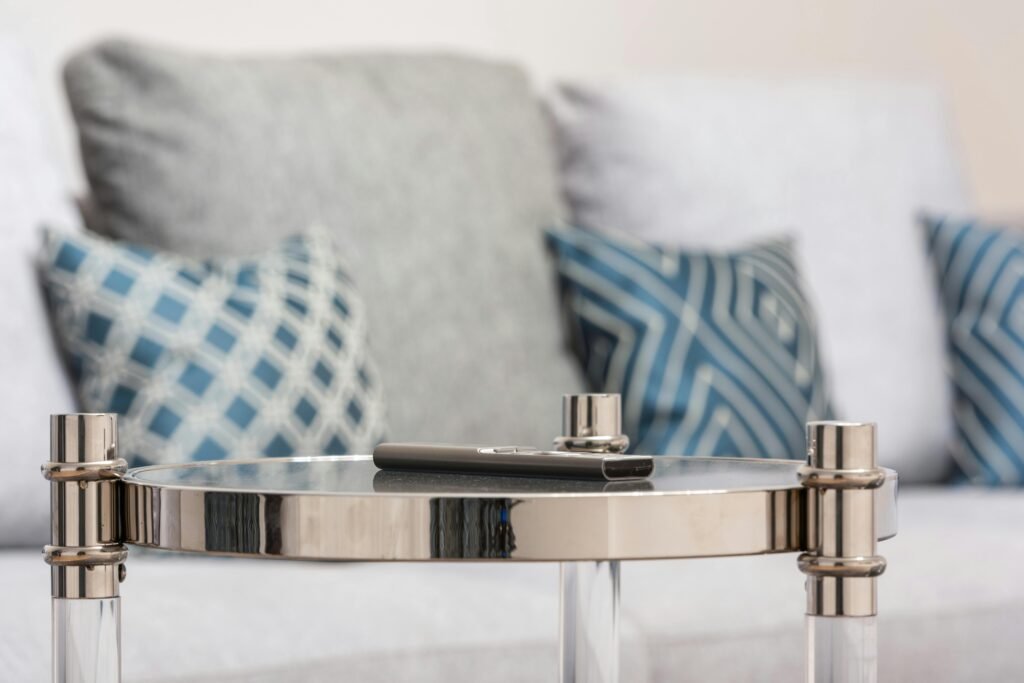
That’s why lighter options tend to work better, such as glass, light wood, or slim metal frames.
Glass tables, in particular, get a bad reputation. However, they visually disappear, which can make a room feel significantly bigger.
Meanwhile, bulky dark wood can feel oppressive fast — unless the room is already very airy.
Styling Without Clutter (A Delicate Balance)
Here’s the rule: if your coffee table is small, your styling should be smaller.
Aim for one tray, one book (or two, max), and one decorative object.
That’s it.
Anything beyond that turns into chaos disguised as “character.” Also, leave space for actual use. A coffee table that can’t hold a coffee is just a decorative platform. And that’s rude.
Final Thoughts: Choose Peace, Not Furniture Regret
At the end of the day, your coffee table should make life easier. Not harder. Not bruisier. Not cluttered with guilt and unread magazines.
When chosen well, it supports your sofa, complements your layout, and quietly does its job without demanding attention.
Which, honestly, is all we can ask from furniture — and most people.